
Stay up to date with the latest news from LEAD Conservation
Stay up to date with the latest news from LEAD Conservation

Four of Kenya’s most respected conservation organisations—Big Life Foundation, Wildlife Works Kenya, Mount Kenya Trust, and SORALO—have come together to form the first regional cluster to formally adopt and implement the Integrated Threat Reduction (ITR) framework, developed and supported by LEAD Conservation.
This marks a pivotal moment for conservation in East Africa, as collaboration, professionalism, and structured decision-making take centre stage in tackling the complex, evolving threats facing protected areas today.

Big Life Foundation operates across the Greater Amboseli ecosystem in southern Kenya, where hundreds of community rangers protect wildlife and wild lands. Until a few years ago, training for these rangers relied on external instructors, often offering one-size-fits-all courses with little relevance to local terrain or challenges. The result was patchy skills development, high costs, and limited long-term impact.
In 2018, Big Life made a strategic shift. They partnered with LEAD Conservation, a foundation focused on building in-house training capacity through a “train-the-trainer” model. Rather than cycle in external trainers, the aim was to develop Big Life’s own rangers into instructors—embedding a long-term solution within the team itself.
With support from LEAD Conservation and the Thin Green Line Foundation, Big Life established the Amboseli Conservation Academy, a permanent training centre that could host multi-week field-based programmes. Early courses included advanced first aid, tactical patrol skills, wildlife crime response, and crucially, teaching and leadership methods. LEAD Conservation instructors delivered the first waves of training, with a focus on preparing Big Life rangers to take over instruction themselves.
This model worked. Within two years, Big Life had trained its own instructors who now run regular refresher courses and induction programmes for all rangers. As of 2023, Big Life is fully self-sufficient in training, having internalised and adapted the LEAD Conservation curriculum to fit its operational context. Materials have been translated into Maa where needed, and lessons are taught using field demonstrations and oral storytelling to reach every member of the team.
The collaboration between Big Life and LEAD Conservation formally began in 2018, marked by the establishment of Big Life’s Amboseli Conservation Academy (ACA) and the first LEAD Conservation training courses for Big Life staff. LEAD Conservation’s team worked closely with Big Life’s leadership to assess training needs and design a programme suited to their operations. From the outset, the partnership focused on a “train-the-trainer” model: rather than simply putting all rangers through one-off trainings, the emphasis was on selecting and upskilling a cadre of Big Life rangers who could become instructors themselves. These local instructors would then continuously train their peers in the field, multiplying the impact.
The results speak clearly:
The success of the partnership lies in its practicality. Training is tailored to the landscape, based on what rangers actually face. Rangers train in the bush, in their own language, led by their own colleagues. It builds pride, ownership, and real competence.
One of the strongest outcomes is cultural: rangers now see themselves as both protectors and professionals. Instructors have emerged from all backgrounds, including those without formal education. As one senior ranger put it: “I never went to school, but now I train others. I’ve saved lives because of what I learned.”
This collaboration shows what happens when training is treated not as an event, but a system. LEAD Conservation’s lasting contribution is not just skills—but the ability to keep teaching those skills long after they’ve left.
Big Life and LEAD Conservation continue to collaborate, sharing lessons with other conservancies and adapting the curriculum as new threats emerge. This is training done right: respectful, practical, and lasting.
LEAD Conservation and UF PRO have released a compelling four-part YouTube series titled Pro’s Guide to Tracking with Rangers and K9s, offering an in-depth look into the real-world application of tactical tracking in conservation. Filmed in South Africa, the series immerses viewers in anti-poaching operations that combine the ancient art of tracking with modern canine deployment—set against the backdrop of high-stakes wildlife protection.
The series follows rangers and dog handlers as they navigate complex terrains, respond to incursions, and work through the pressures of time, heat, and operational uncertainty. Structured like a mini-documentary with real-world scenarios, it explores how visual tracking and scent-tracking dogs can complement each other in identifying and intercepting suspects linked to poaching and illegal activities.

Conservation threats don’t wait. They move fast, adapt quickly, and rarely follow a script. That’s why we’ve launched Integrated Threat Reduction (ITR) — a structured, tiered approach to conservation security that helps teams on the ground take control of the threat environment, not just react to it.

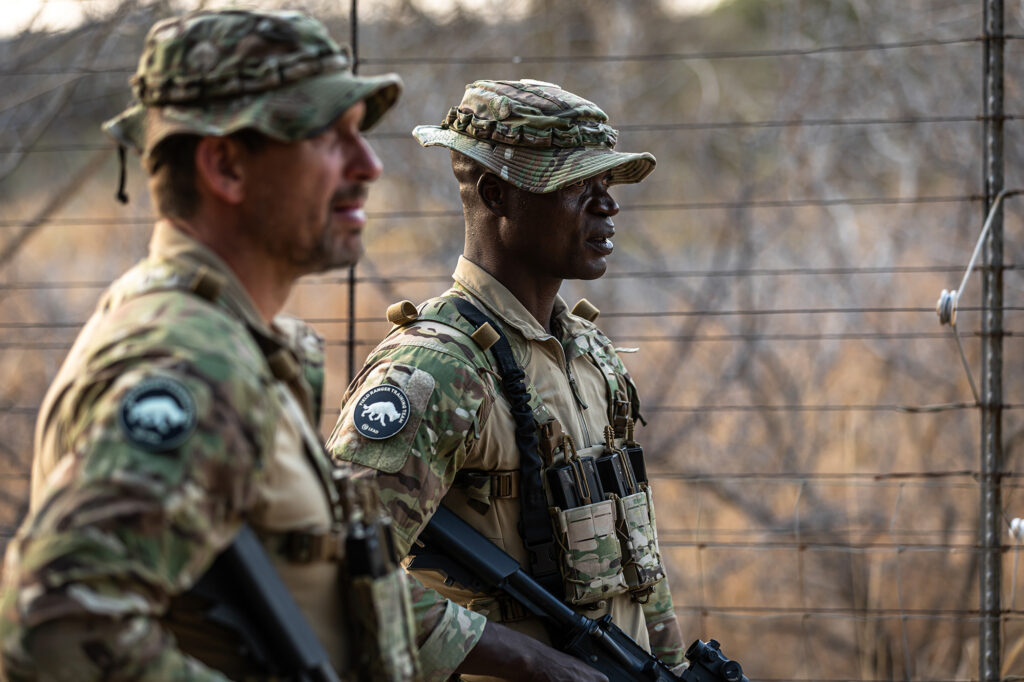
In the vast, untamed wilderness of Zimbabwe, where the battle for wildlife is fought not just with guns but with knowledge, the Akashinga Academy in Phundundu stands as a testament to what can be achieved when local leadership and a commitment to sustainability are placed at the centre of conservation efforts. This case study looks at how LEAD Conservation’s approach to developing in-house training capacity played a pivotal role in shaping the Academy’s ability to meet its own needs, while also preparing its teams for the unpredictable challenges that lie ahead.
By embedding training within the local context and cultivating leaders from the ground up, Akashinga has shifted the dynamics of conservation training. The result? A more efficient, culturally aligned, and self-sufficient approach to wildlife protection that echoes the wider goals of LEAD Conservation’s work—empowering people to lead and adapt to ever-changing circumstances. But in this world, sustainability is never given. It’s earned. And this story traces how LEAD helped Akashinga carve out its own path to long-term success.
These partners are responsible for the practical application of the ITR framework on the ground. They work directly with local teams to roll out and integrate ITR strategies into daily operations.
We collaborate with these organisations for their expertise, research, and insights that help shape and refine the Integrated Threat Reduction (ITR) framework. They play a critical role in developing strategies, new tools, and training modules, as well as sharing best practices.
Support partners assist with resources, funding, logistics, and additional services that complement the ITR rollout. They help ensure smooth operations and fill gaps that may arise during implementation.